
Softwood cuttings: How to steal shrubs and trees without digging
Not that I am advocate of theft, but it happens. It is one of the dirty little secrets of the gardening community. We gardeners are just obsessive compulsive sometimes and when we see a plant we have to have, we will do anything to have it, including steal.
But like the Mafia, gardeners have a bizarre Code of Honor when breaking the law. Outright theft is a big no-no (unless the building is due for demolition or is very abandoned but that is another part of The Code that we will look at another day), but stealing just a little part of the plant is not beyond us. Some of us even carry pruning shears around with us in the event that we find That Plant which requires us to break the law.
The trick is to know what part of the plant to take to guarantee that when we get home we will be able to grow our ill begotten cutting.
Softwood cuttings are how many trees and shrubs are propagated. Softwood cuttings are best taken in spring when the softwood is, well, softest. Softwood refers to the new growth on a tree or shrub.
The easiest way to tell if a plant is good softwood candidate is to look at a branch. The softwood will look and feel like a regular plant, soft and easily crushed between your fingers. The softwood will lead down to the hardwood , which will feel like a normal tree branch, with a rough bark (or bark-like) covering and hard to crush. The softer the wood the better the cutting will root. As soft wood ages, it becomes more and more like hardwood.
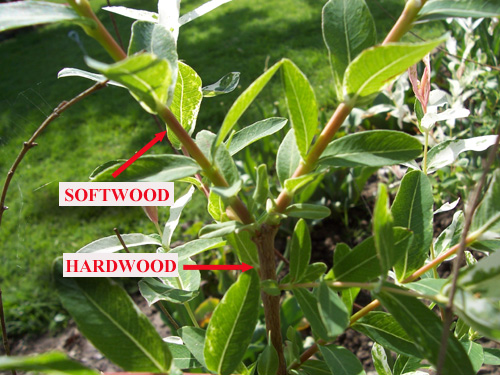
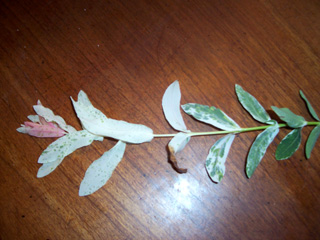 Once you have determined where the softwood is, take a 4 – 8 inch cutting of the softwood. If there is no 4 inch piece of softwood, you may have a difficult time getting the cutting to root.
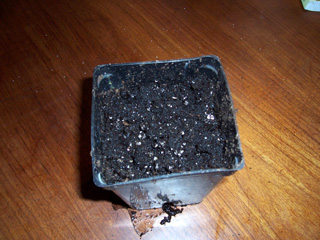 Get a pot of soilless potting mix. This is “dirt” that has no dirt meaning the stuff you find in your yard. Most container mixes you buy at the store are soilless.
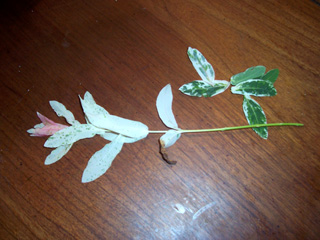 Strip the leaves off the bottom half to third of the stem.
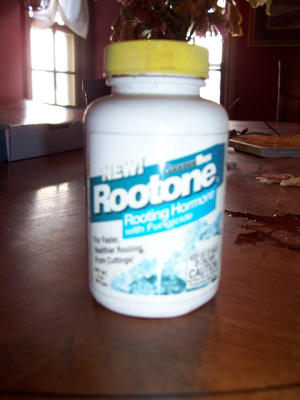
Dip the stripped part of the stem in water and then in a rooting hormone like Rootone. The stripped part of the stem should be covered by the rooting hormone.
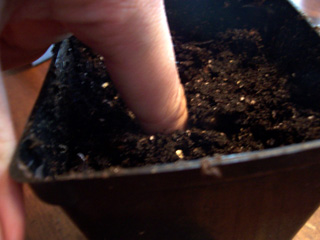 Stick your finger in the soilless mix to make a hole.
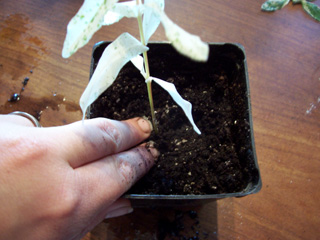 Stick the cutting in the hole and push the dirt around the cutting with your fingers. You do this so that the rooting hormone will stay stuck to the stem. If you just shoved the cutting into the dirt, the rooting hormone would be left on top of the dirt.
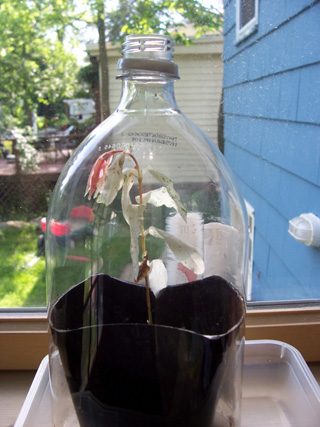 Place the cutting in indirect light and try to keep it moist and in a humid environment. The best way to do this is to make a soda bottle cloche. It is made the same way as the weed killer shield I made a few weeks ago (except that you don’t spray weed killer on the cutting).
Don’t panic if your cutting looks a bit peaked. You would look less than happy too if you were just ripped from your family and shoved in a pot. Your cutting will recover, hopefully. Remember, some cuttings root better than others. Not all of your cuttings will survive. If the first cutting doesn’t survive, go back and steal another one. Or just ask. Most gardeners are happy to share.
NOTE: No cuttings were stolen in the making of this webpage. Thanks to my neighbor Maxine for letting me take a cutting of her Hakuro Nishiki Willow
I think this kind of tongue-in-cheek approach to theft is unacceptable. Let’s stick with approaching the owner of the plant you so badly want, and asking politely for a slip in exchange of one of yours, or offering to pay for your so-badly-desired object. It’s bad enough that folks come by and feel comfortable stealing the whole tree, as happened to us this week, without this kind of on-the-edge-of-honest methodology being offered online. Whatever happened to a civil society which had respect for the honest effort of others?
Perhaps you should have read to the bottom of the post before passing judgment. 😉
Sorry, Hanna, I did read the complete post before making the comments about theft. And i am sure that there only a few folks out there who would stoop to taking the whole tree! But they sure don’t need any more incentives to feel that is OK. on the bright side, in my neighbourhood we enjoy sharing the plants that thrive in our particular patches, and if you lived in the neighbourhood, i’m sure we’d be happy to provide you with a cutting or two. I’m just smarting from the brazen theft of one of the underside of the gardener’s species!
I would never in a MILLION years steal some one elses entire plant or tree for that matter….but I will about once a year pick one of my friends to give a very large floral arrangement created soley from flowers that I have picked from other peoples yards…I will pick a single flower from very healthy plants only that have more than three blooms on them…and really one flower from each yard only…It makes me feel like a diviant and like I am doing something nice for some one elese….But I cant believe some one would be so ruthless as to steel an entire tree…WOW!!!!!and I love the idea of small clippings to create an even more grand garden of my own….thank you!!!!
Can these cuttings which are taken in the spring work for a Cherry tree? Is the new growth considered “softwood” even though it is not soft? Thanks,
Courtney
Nellie’s comment is absurb. Over the years many gardeners have helped themselves to occasional small cuttings of our specimens, and I don’t mind. It’s part of the hobby, and it’s part of sharing with the community. Many decades ago, I brought a Sugar Fruit from Taiwan to a small Japanese Island. We planted it and it grew well. On returning several years later, we noticed that the entire neighborhood was growing Sugarfruits to enjoy. How WONDERFUL!
Something all good gardeners know but often forget: many of those wonderful trees only came about due to a lot of effort from research and development that costed lots of money. A healthy young plant does not cost a fortune ann you will grow to become an adult sooner than trying to propagate your own. Also, the commercial nurseries and growers also get to have a living. It is same as copying a music CD illegally. Many plants are protected by trade mark and may only be propagated by a licensee. So, have a heart and support your nurseries as well as having fun with propagation.
Is there any way that you can do a softwood cutting without the hormone? Just wondering… Thanks!
I am sure you can do cuttings w/out the hormone, the hormone is just a catalyst. The Rootone may also contain some fungicides which means you may want to nuke or bake your rooting (soil) mix, sterilize it before using the “soil”, which I consider best practice anyway.
I support Hanna, I appreciated this articles candor and individual perspective. In fact the article dovetails perfectly with the blog title “This Garden is Illegal”.
Hanna, Thanks for the tongue-in-cheek summary – I highly doubt this promotes theft out in the real world -although I have had people clip my entire sunflower heads of 12″ (all of them) and my neighbor’s also had their tiny evergreens dug up – but I doubt they read this and ran with it (since it was four years ago). Most gardeners tend to ask neighbor’s permission, but in a park or greenbelt island, people secretly clip a smidgen of a branch to create new life elsewhere. I laughed when I read this – but just today attending an estate sale, I saw wonderful geraniums and a lantana – the owners looked at me a bit weird when I asked, but said gladly go ahead when I told them I just wanted 4″ of a branch and their lovely flowers would not be harmed 🙂 Even one of their neighbor’s walking by commented on “good luck” cloning them.
Pingback: Green collar crime | Sentinel Weekly News
Pingback: The Friday Debate: Green collar crime - do you take plant cuttings without permission? | Better Gardening Tips
Pingback: The Friday Debate: Green collar crime - do you take plant cuttings without permission? | Better Gardening Tips
Well, I just did this, and I still feel a little guilty. On a side street near where I live there is this rose bush I’ve had my eye on for quite some time. An old tea rose that looked like it might be “Ducher.” For quite a few weeks I was thinking about stealing a cutting, but hesitated–until the day I saw they had mercilessly pruned it down to one or two canes. (Tea roses rarely need pruning, and certainly never to that extent.) So I noticed today it had bloomed again–so yep–I snipped a couple of stems with flowers.
How petty. Just taking a piece is no big deal!!!
someone has been coming in my yard…pulling up my lilies and my hostas. its not petty.. its not cute..its thievery! you can dress it up anyway you want to…but if you have to cross onto someone else’s property to get it…you’re a thief. Why not ask for it…or better yet…go buy it.
I think that is a great idea and it is cute how she worded it. I sometimes take cuttings from the park and re root, it doesnt hurt anything, more oxygen 😉
I was searching through some pages and I found this interesting blog. This is my first year planting flowers; I usually plant vegetables and fruits. I’m growing new plants out of the seeds I got from the flowers to share with my mom and fill her garden with flowers. It’s sad that some people steal pots full of flowers or even cut fruit when it hasn’t ripen. It’s okay to take a little piece of the plant when it’s peeking out of a gate or a fence, but getting inside somebody’s property … that’s not acceptable. There’s always a downside to this because not everybody cares about your plants and they tend to pull pretty hard and end up taking the whole bush or even the whole pot if they dare. I agree that It’s better to ask the owners, and if this is not possible well a little branch won’t hurt, just do it respectfully by just cutting a little without harming the plant or thinking to take almost the whole plant.
Melanie: That’s really kind of sweet, I would be so honored to receive a stolen bouquet from a friend. XD;
I would never steal an entire plant either, but I do take cuttings and pull up bits of trailing or self-multiplying plants from inconspicuous spots. (especially where they’ve leaked outside of the garden’s boundaries, if I can.) But I won’t touch something that won’t grow back, no matter how tiny, and I won’t go more than a step or two into someone’s property.
My code of honour is intact – I’d never do anything to damage another person’s plant, but if they were willing, I’d take a cutting and also share mine. I haven’t yet (and I don’t know if I would) taken a bit without asking. The copyright thing is a bit silly, unless someone was actually selling cuttings.
I am in the process of making a whole bunch of cuttings from my garden for our local school, to save them money and get the kids involved in their garden. I wouldn’t have a clue which plants in my garden are copyrighted and which aren’t.
Hiya,
Just wondering how long a cutting might take to grow fruit?
I am renting a house at the moment, with a very prolific lemon tree in the back yard. I could go buy one from a nursery, sure, but I know this one makes lovely lemons, and I want to take a bit of it with me when I go (anywhere from 3-9 months from now).
I would also like to try growing some from seeds, but have heard a cutting will produce more of a clone, and you can’t be sure what you’ll get from seed…
Is a cutting guaranteed to produce fruit, and what is the time period for fruit on a cutting? Should I make a few just in case one or more don’t produce fruit?
You’re right about the difference between cuttings and seeds. If you root a cutting of the lemon tree, it will be an exact replica. If you plant seeds, however, you will not get an exact replica, and more likely than not, it will be inferior.
I can’t answer your question about how long it will take a cutting to bear fruit. My guess would be several years, at least.
Another thing to keep in mind is that fruit trees are often sold grafted. Cuttings are taken from the desired fruit tree, and inserted in rootstock of another, usually more vigorous variety. The vigorous rootstock often helps the cutting reach maturity sooner than the cutting would alone on it’s own roots.
If I were in your place I would take several cuttings to be sure I get at least one to root. Then, if after you move you decide you want a fruiting size tree sooner, then buy something at a nursery, and still continue growing your cutting. Some day you will have two lemon trees, or when your cutting reaches maturity, you can give the other one away if you only want one.
On a semi-related note on the ethics of this, I also would not even take a small cutting without asking first.
However, is what I have done just as bad?
Specifically, I have craftily planted raspberries and black-caps in copses in public parks in the city in which I live. There is something satisfying about seeing them growing there, year after year, spreading out, and being eaten by kids, including my own. But it is a form of trespassing. What does everyone think?
I have been stealing cuttings since i was a teenager. so relived to hear that i am not abornormal. if i caught someone stealing my plants, i would not mind too much though.
I really enjoyed the article and commentary. We are traveling back home through mass to ct and while I wait for my hubby to grab lunch from the mall ij the middle of somewhere, I am debating taking a cutting from a gardinia bush… but i feel too guilty!! Maybe nexttime.. 🙂
I appreciate your sense of civic duty @Nellie, but the blog is titled This Garden is Illegal. Just sayin’.