
No Those Are Not Baby Plant Wings: Cotyledon Leaves
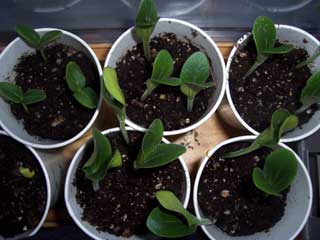 So you planted your seeds, you gave them good dirt (you are one ahead of me) and you watered them all nicely and *voila* little baby plants grew up where your seeds had been. Lucky you.
But you may have noticed that your little baby plants don’t look at all like big, grown up plants. They have these fat, short leaves that look like little wings about to fly away. Don’t Panic! These are not omens of an early plant death to come and a promised plant paradise to follow , but rather these are the Cotyledon.
Many times people refer to these as the false leaves, the first leaves, the seed leaves or those “one leaves” (since they don’t know what to call them).
The first leaves can be thought of like a yolk in an egg or a placenta in a mammal. These leaves help to provide food to your baby plant while it is getting a hang of this whole photosynthesis thing.
Not all cotyledon’s are alike. Some develop into those distinctive leaves while others stay hidden below the ground to help feed the plant from a more discreet location. Sometimes, the cotyledon is so large and sturdy in a plant that you can inscribe words on it and make a small fortune selling them as novelty gift. Other times, if the plant has other sources for pre-leaf food, like an endosperm, the cotyledon will be almost non-existent.
Not all plants are equally blessed with cotyledons. A plant that has one cotyledon is known as a monocot, while one that has two is known as a dicot. If a plant has three or more of them, this is commonly referred to as a freak of nature or a pine tree. Careful examination of the plant in question will reveal which it is.
If, by chance, you happen to break off the true leaves after they have grown a bit and the cotyledon leaves remain, they can keep a plant alive for a very long period of time. Unfortunately, the plant will not grow new true leaves though and thus will not grow any larger or produce flowers or fruit.
If a plant without endosperm loses its cotyledon before it has its true leaves, the plant will die.
When the plant has enough chlorophyll producing true leaves to sustain itself and the food in the cotyledon has been used up, the plant has no need for them anymore. If all goes normally, eventually the cotyledon leaves will die and fall off.
Which begs the real question, do you think that there is a cotyledon fairy that takes the seed leaves your plants lost and places the plant equivalent to $.25 under their little plant pillows?
I am wondering if I can use your picture of baby plants for my daughter’s elementary school newsletter. We are trying to get volunteers to work in the school garden.
Thanks,
Eileen Armstrong
Pingback: Helmet Head – When Emergency “Seed” Section Is Needed